Research & Frameworks · Second edition · October 2026
The Studio Governance Model™
Reliability and organizational judgment in AI-assisted work
A proposed framework for mission-driven organizations to make AI-assisted work easier to examine, challenge, and govern—while keeping human judgment at the center.
Download the White Paper (PDF)Second edition · 15 illustrated pages · Free download · No registration required
This is a proposed governance framework. The paper does not report a completed evaluation or establish that four roles, multiple agents, or multiple models improve reliability. Its safeguards and pilot are recommendations for testing in practice.
The framework
Four roles. Visible responsibilities.
The model separates exploration, interpretation, creation, and authorized execution. These are responsibilities within a workflow; they do not require four employees, four products, or four autonomous agents.
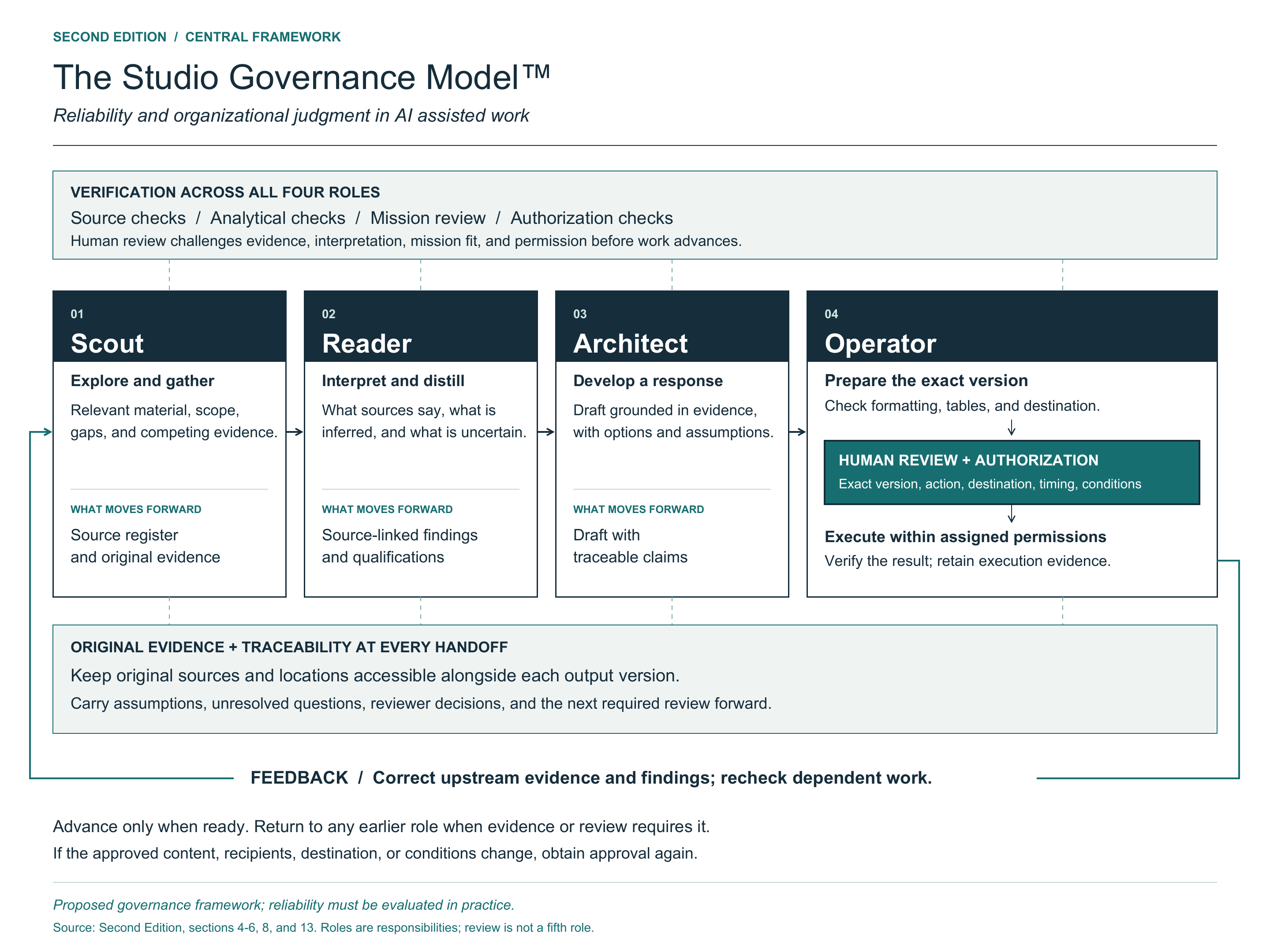
Select the diagram to view it at full size.
01 / Scout
Explore the question and gather relevant material, including gaps and competing evidence. Retain a source register and original evidence.
02 / Reader
Interpret and distill what sources say, what is inferred, and what remains uncertain. Carry source-linked findings and qualifications forward.
03 / Architect
Develop a response grounded in evidence, with traceable claims, options, and explicit assumptions.
04 / Operator
Prepare the exact version for human review and authorization. Execute within assigned permissions and verify the result.
Evidence, judgment, and permission
The second edition begins with AI unreliability: fluent work can be wrong, and accurate work can still be poorly suited to an organization’s mission. It proposes source checks, analytical checks, mission review, and authorization checks across all four roles.
Original sources and their locations remain available at each handoff. Important claims are checked in context, uncertainty stays visible, and a named authorized person approves consequential actions. After execution, the result is checked against what was approved.
The paper also examines AI drift and cognitive monoculture. Different models can repeat similar assumptions and errors; tool variety alone does not establish independent reasoning or reliable work.
Start with a contained pilot
An illustrative nonprofit grant-report pilot and a proposed six-week learning cycle offer a practical starting point. The evaluation plan compares the workflow with current practice using errors, omissions, traceability, review effort, time, cost, mission fit, and authorization-control performance.
The aim is evidence for a decision to continue, revise, or stop. No pilot outcomes are claimed.
Download the White Paper (PDF)